
Equipment note
Trail Shoe Lugs for Mud, Wet Rock and Hardpack
September 26, 2026
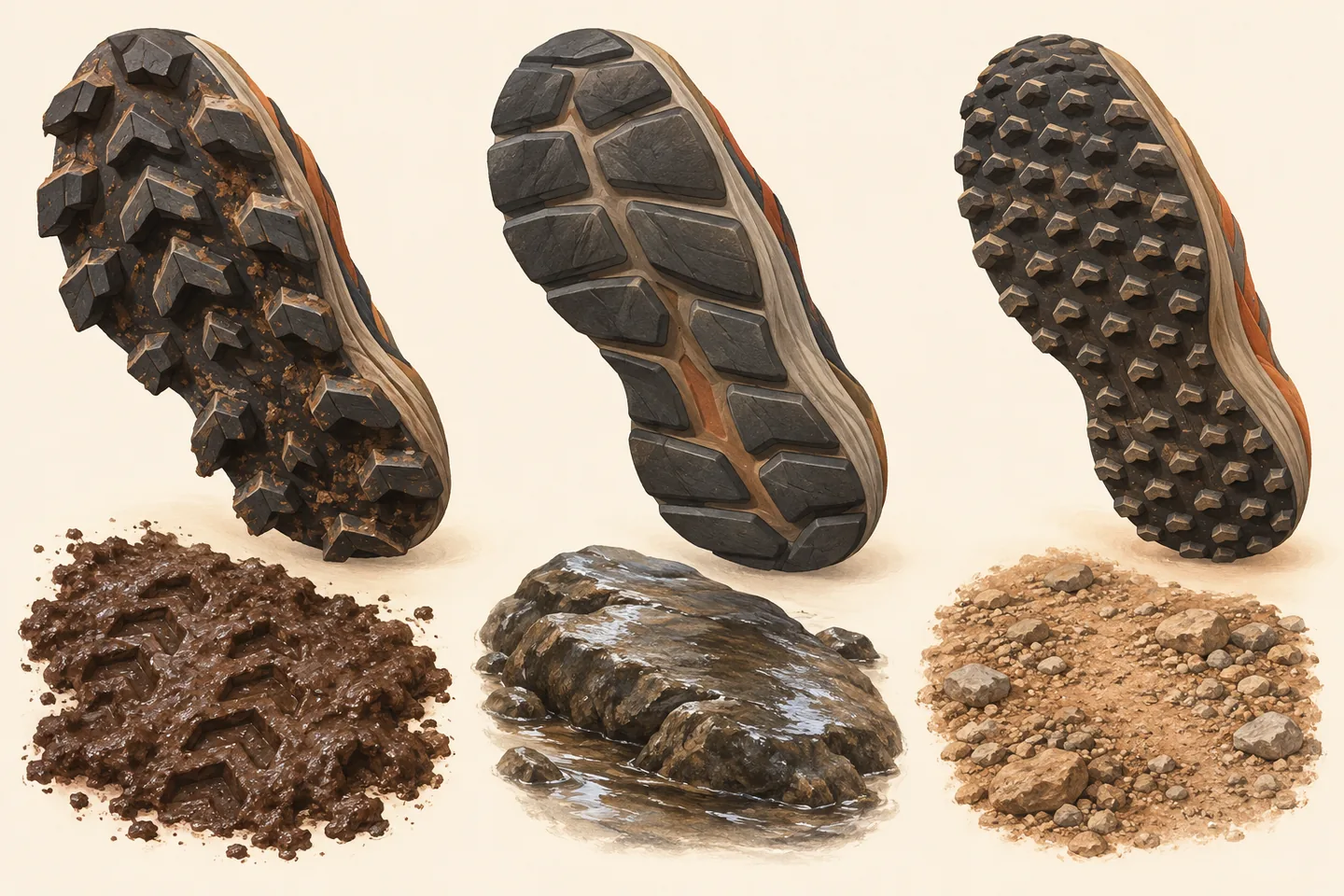
A trail shoe can feel secure on a muddy climb yet uncertain on wet stone. Another may run smoothly on packed paths but struggle when the soil softens. The outsole matters: lug depth and spacing affect how the tread meets loose ground, while the rubber and contact area matter on firm surfaces. Choose for the routes you actually run, including any pavement between home and the trail.
Start with the whole route
List the surfaces on a familiar run from door to door. How much is paved? Does a shaded section stay muddy after rain? Are the rocks rough and broken or broad and smooth? A route called “trail” can require several kinds of grip in a short distance.
Consider both how often you meet each surface and what happens if you lose footing there. A brief, level muddy patch may call for care rather than a specialised mud shoe. A muddy descent you run every week deserves more weight, even if it makes up little of the route. The same applies to a wet rock crossing where you routinely slow down.
Count road links honestly. REI notes that regular pavement use can wear those soles more quickly. If every run begins with a long paved approach, consider how the tread feels and wears there as well as how it grips off road. No outsole can optimise every surface at once.
What lug shape tells you
Lugs are the raised parts of a shoe’s tread. On soft ground, they can press into soil and provide edges to push against it. The spaces between them leave room for displaced mud and help the tread shed it as the foot lifts. On hard ground, there is little for a deep lug to enter; steadier rubber contact becomes more relevant than depth alone.
Salomon distinguishes deep, widely spaced lugs for muddy ground from shorter, closer lugs for dry, packed trails. REI makes a similar distinction in its trail-shoe outsole guide. Treat these as ways to narrow your options. Lug shape, rubber and the feel of the whole shoe can still differ within either category.
Inspect the complete outsole rather than judging one dramatic heel lug. Look for useful edges under the forefoot where you push uphill, and at the heel where you control a descent. Check whether the spaces between lugs remain open across the sole. A tread that appears aggressive from the side may have crowded areas where sticky soil collects.
Mud: depth and room to release soil
For frequent soft mud, start with deeper lugs and clear gaps. A lug that reaches into loose ground can find more purchase than a shallow tread resting on top. If mud packs into every gap and stays there, the outsole may lose the pattern you selected. More open spacing gives the soil somewhere to move, although no tread can guarantee grip in every kind of mud.
Consider what lies beneath the surface. Deep, soft earth differs from a thin slick layer over hard ground. On the latter, tall lugs may reach the firm base, but footing can still change abruptly from step to step. Heavy clay may cling to a sole that sheds looser soil. These differences are reasons to judge a shoe on your usual route rather than on the label “mud”.
A dedicated mud tread can feel less settled on stone or pavement. If mud is occasional and most of the run is firm, a moderate pattern may be the more useful compromise. Shorten your stride and slow down through isolated slippery patches. If muddy climbs and descents define most outings, prioritise the open tread and accept its different feel on hard sections.
Wet rock: rubber contact matters
A lug cannot dig into a rock slab as it can into soil. On broad stone, inspect how securely the tread sits when you put weight on it and how much rubber actually meets the surface. REI distinguishes durable firmer rubber from softer, stickier compounds used for grip on rocky terrain. Lug height alone therefore gives an incomplete picture of a shoe intended for rock.
Do not treat a rubber name or a “wet grip” claim as a guarantee. Smooth wet stone, rough stone, roots and rock coated with mud are different surfaces. A shoe may feel reassuring on one and uncertain on another. If tall, narrow lugs seem to move beneath your foot on firm ground, that movement may also make precise placement harder.
The upper matters when you place a foot on a small rock or change direction. Your foot should stay centred over the sole rather than slide inside the shoe. A rock plate may make sharp ground more comfortable, but protection underfoot does not establish how well the outsole grips. Assess those features separately instead of assuming a protective shoe is a secure one on wet stone.
Hardpack and gravel: favour a steady ride
Dry, packed paths give deep lugs little to penetrate. Shorter, closer tread usually offers a more consistent feel on this ground and on the firm paths that connect it. The trade-off appears when rain softens the route: the same shallow pattern has fewer pronounced edges to work in loose soil.
Gravel needs a closer look. A thin scatter of stones over firm dirt is unlike a deep layer that shifts under every step. Consider which condition you meet and whether the shoe feels predictable as you turn or descend. Even a suitable tread cannot replace deliberate foot placement on loose stones.
If your runs are mostly hardpack and pavement with one short muddy section, avoid choosing the most aggressive tread solely for that section. Conversely, a smooth outsole that feels pleasant on the approach may be a poor match for a weekly muddy descent. Let the demanding recurring surface set the priority, then check the compromise on everything around it.
Check fit alongside grip
An outsole helps only if the shoe holds your foot securely. Try both shoes with the socks and any insoles you normally use. Your toes need room, but your forefoot should not slide and your heel should stay seated. REI places fit at the centre of its trail-shoe selection advice; assess the fit you have now rather than assuming discomfort will disappear later.
Where safe and permitted, walk up and down an incline and make a few controlled turns. On a descent, notice whether your toes hit the front. On a turn, notice whether your foot moves inside the upper before the sole follows. Laces can correct modest looseness, but a shoe should not need painful pressure to stay secure.
If a short test on a familiar route is possible, begin slowly. Notice where the sole feels steady, where mud remains in the tread and where you instinctively shorten your stride. Test the shoe on its intended surfaces as well as the links between them. A single confident step on dry ground tells you little about its behaviour on wet rock or a muddy slope.
Choose the compromise deliberately
For mostly firm paths, begin with shallow or moderate tread and check how it handles the occasional soft patch. For frequent deep mud, examine lug depth and open spacing. For routes defined by wet rock, give rubber contact and secure foot placement more weight than lug height. On mixed routes, choose the condition where dependable footing matters most, then make sure the shoe remains comfortable and predictable over the rest of the run.