
Equipment note
Heel Slip or Tight Toes? A Running-Shoe Fit Check
September 26, 2026
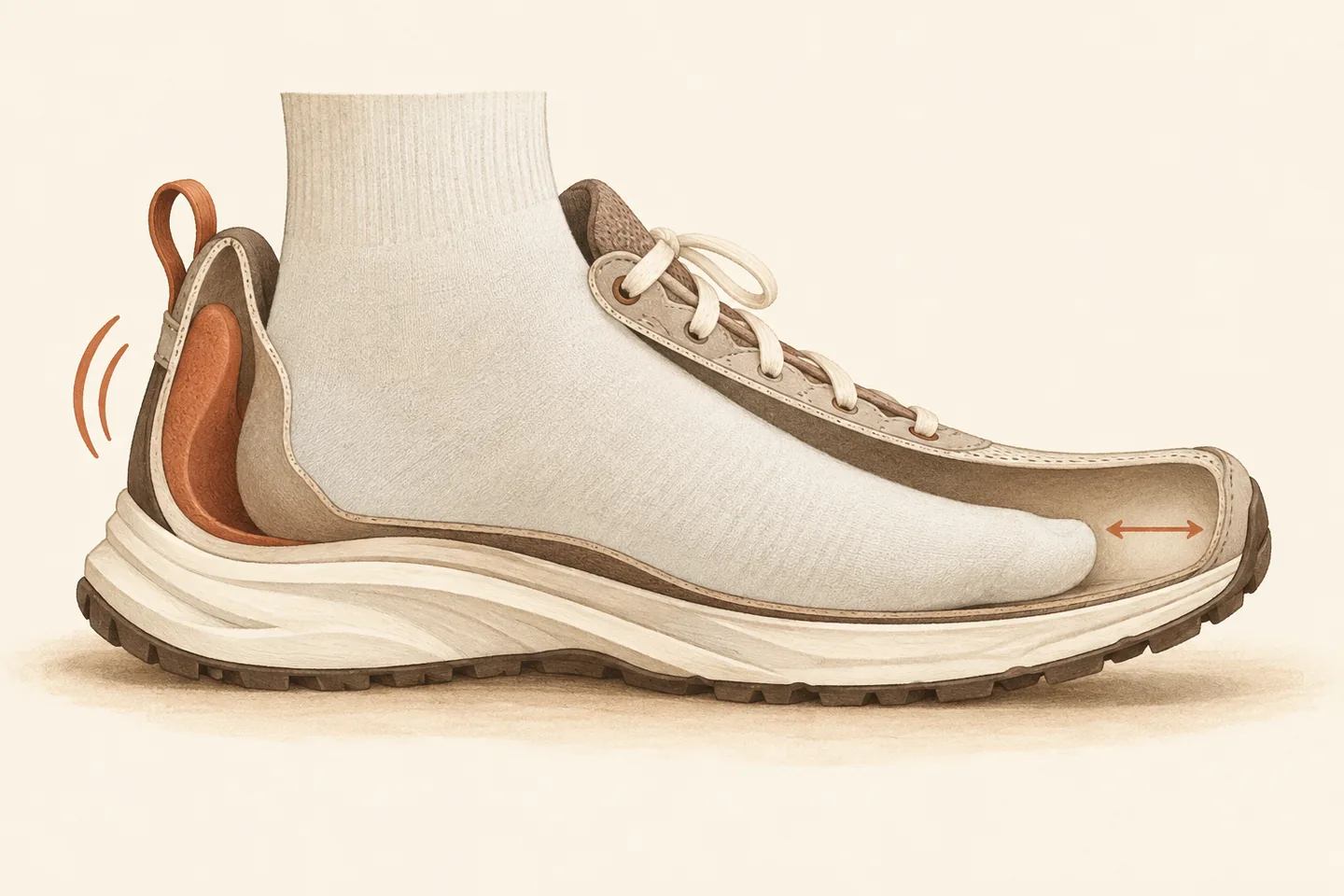
A running shoe can feel loose at the heel and tight at the toes at the same time. Going up a size may ease pressure at the front, but it can also leave more room for the foot to slide. Check length, forefoot shape and heel hold separately before deciding what to change.
Start with length and forefoot space
Try on both shoes with the socks and insoles you intend to run in. If you use orthotics, bring them too. Feet can swell during the day, so REI recommends fitting running shoes at the end of the day. Begin with the shoes laced at a comfortable tension and your heels settled against the back.
Stand with your weight on both feet. Locate the end of the longest toe in each shoe; it may be the second toe rather than the big toe. Feel the gap between that toe and the front of the shoe. REI suggests roughly a thumb’s width. For trail shoes, Salomon suggests about a centimetre ahead of the toes. These are useful starting points, not a reason to ignore how the shoes feel when you move.
Check each foot rather than assuming the pair fits because one side feels right. Your toes should have room to move without being pressed together at the sides or pushed down by the upper. Space ahead of the longest toe does not solve pressure across the forefoot. Conversely, a wide toe box will not help if the toes repeatedly hit the front. Note exactly where any pressure occurs: at the end, along the sides, or over the nails.
Walk in the shoes and jog briefly if you can. Watch for toes meeting the front as your weight moves forwards. For trail shoes, a gentle decline can reveal sliding that is less obvious on level ground. Keep the fit check comfortable and natural: do not curl your toes or hold your foot deliberately back to make a short shoe seem adequate.
Find out how the heel moves
Once the forefoot is checked, pay attention to the heel and midfoot. Walk at an ordinary pace, then take a few quicker steps. A slight change in sensation as the shoe bends is different from a heel that repeatedly lifts, rubs or feels ready to come out. The midfoot should hold the foot without pinching it.
Notice whether movement is confined to the back or whether the whole foot shifts inside the shoe. Loose laces may allow an otherwise suitable shoe to move. A broad heel cup may leave the heel poorly held even when the midfoot feels secure. If the entire foot slides forwards, there may be too much room through the shoe. This distinction matters because added length cannot fix a loose heel and may increase the movement.
Compare what you feel at the heel with what you found at the toes. A heel that lifts while the toes have enough space points towards a hold or shape problem. Toes squeezed at the sides despite sufficient length point towards width or toe-box shape. Toes touching the front while the heel stays seated suggest that more length may be needed. If the toes strike the front only when the heel slips, secure the heel first and check again.
Test a runner’s loop
If length and forefoot space seem right but the heel moves, try the extra top eyelets if the shoes have them. A runner’s loop changes the hold near the ankle without changing the size. It is a test of whether the shoe can stay secure at a comfortable lace tension.
- Lace normally until you reach the second eyelet below the top on each side.
- Feed each lace end through the top eyelet on the same side, leaving a small loop.
- Cross the ends and pass each through the loop on the opposite side.
- Pull to close the loops, then tie the laces as usual.
These steps follow REI’s runner’s-loop instructions. Walk and jog again. Check whether the heel stays seated and whether your toes still slide forwards. Do not pull so hard that the top of the foot or the ankle feels compressed. If you feel tingling, numbness or a new pressure point, loosen the laces and reassess. Better heel hold is useful only if the rest of the shoe remains comfortable.
A loop cannot make a narrow toe box wider or add length to a short shoe. It may also fail to hold a heel in a cup that is simply too broad. If securing the heel requires painful tension, compare another shoe shape rather than accepting discomfort. Lacing can refine a close fit, but it cannot turn a poor fit into a good one.
Choose the change that matches the problem
Heel slips, toes have enough room: Try the loop and repeat the movement check. If the heel still lifts, compare a shoe with a closer heel fit or less room through the midfoot. Increasing length is unlikely to help a shoe that already moves too much.
Toes feel tight at the sides, but there is space ahead: Compare a wider fit or a different toe-box shape at the same length. You can loosen the forefoot laces to see whether upper pressure is part of the problem, but laces cannot change the width of the sole. Check that the heel remains secure after any adjustment.
The longest toe reaches the front: First settle the heel and check whether the foot is sliding forwards. If comfortable lacing stops that movement, reassess the length in motion. If the toe still lacks space, try a longer size and repeat the heel and midfoot checks. A longer shoe is useful only when it also holds the rest of the foot.
Heel hold creates pressure elsewhere: Ease the laces. If a secure heel always means pressure over the foot, or a comfortable forefoot always means a loose heel, compare another fit. One adjustment should not merely move the discomfort to a different place.
When comparing pairs, use the same socks and insoles and test each pair in the same way. Change one variable at a time: first try a different width at the same length, or a different shape at the same marked size. Do not assume that two shoes with the same size label will feel alike. After each change, repeat the standing toe check and the short walking test. A pair that solves one problem can introduce another, such as a steadier heel with too much pressure across the forefoot. Check the whole fit before choosing.
Make the final check in motion
Give more weight to a repeated sensation than to one awkward step. Walk, turn and jog briefly where permitted. Check both shoes after moving: the fit may differ between feet, and the laces may settle. Look for room ahead of the longest toe, space around the forefoot and a heel that remains comfortably seated. If you can only stand in the shoes, treat the result as provisional until you can assess movement.
Choose length for a real shortage of space at the front, width or shape for pressure around the toes, and a different heel or midfoot fit when comfortable lacing still lets the foot move. The size number is only a starting point; what matters is whether those parts of the shoe work together while you walk or run.