
Equipment note
Do You Need a Rock Plate in Trail Running Shoes?
September 26, 2026
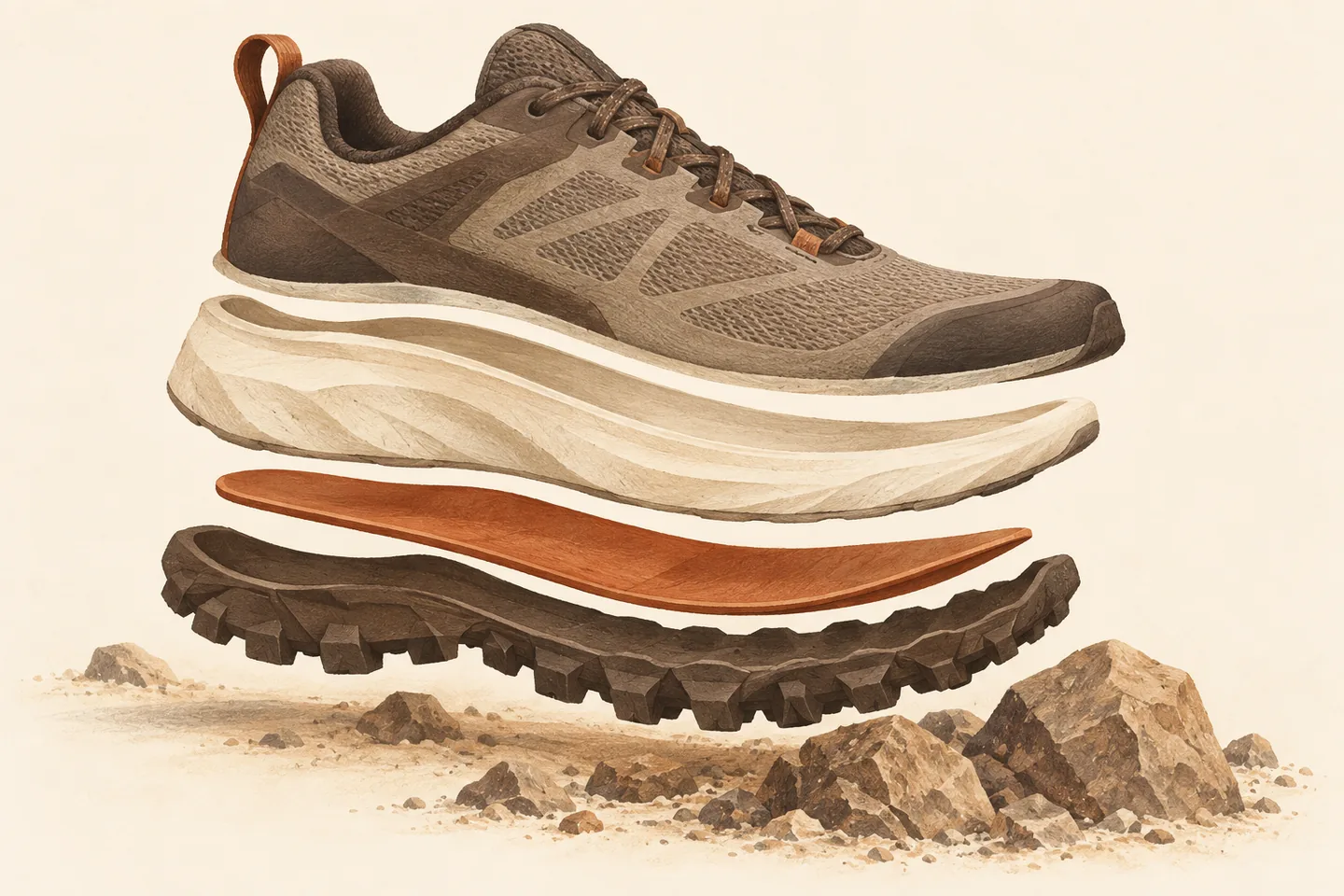
A pointed stone under the ball of your foot can make an otherwise comfortable trail shoe feel surprisingly thin. A rock plate is one way to reduce that sharp, localised pressure. Whether you need one depends on the ground you run, how much you feel through your shoes and the protection the rest of the sole already provides.
What a rock plate does
A rock plate is a protective layer within the sole. Depending on the shoe, it may cover the forefoot or extend farther along the foot. Its purpose is to spread the pressure of a sharp rock or root across a wider area, so one small point presses less distinctly into your foot. REI describes plates made from thin plastic or carbon fibre and notes that their coverage varies between shoes. A longer plate can also make a shoe more resistant to twisting, which may change how it feels on uneven ground. REI’s trail-shoe guide explains plate coverage and construction.
Protection under the foot differs from protection around it. A toe guard helps when you strike an obstacle with the front of the shoe; a rock plate addresses pressure coming up through the sole. Salomon makes that distinction in its guide to trail-shoe protection. Neither feature can tell you whether the outsole will grip a wet slab or a muddy descent.
Protection and cushioning answer different questions
Cushioning describes how the midsole compresses and feels under repeated steps. A soft, deep layer of foam can make a firm path pleasant without necessarily stopping a pointed stone from being noticeable. A plate resists concentrated pressure, but it does not have to make a shoe feel soft. The two features can work together, and a substantial midsole may provide enough separation from the ground for some runners without a distinct plate.
There is a trade-off in feel. Some runners value a flexible forefoot that follows the contours of the trail. Others prefer more separation from angular stones, particularly when fatigue makes precise foot placement harder. REI notes that trail shoes often use stiffer midsoles than road shoes and may include plates for sharp rocks and sticks, while road shoes commonly put more emphasis on soft cushioning for pavement. Its comparison of road and trail shoes is a useful reminder that softness and protection are separate design choices.
Match the protection to your regular routes
Start with the ground you meet on an ordinary run, rather than the roughest photograph you have seen of a trail. A maintained dirt path, a gravel road and a rocky hillside all count as off-road running, but they place different demands on the sole. Note where stones are embedded and easy to step around, where loose pieces shift underfoot and where sharp edges fill most of the available landing space.
On mostly smooth paths, you may find that a comfortable trail shoe without a stated plate gives you all the underfoot protection you want. Occasional stones are a reason to pay attention during a test, not an automatic reason to choose the stiffest sole. If your regular route repeatedly leaves the forefoot tender or makes you shorten your stride to avoid every small rock, added protection becomes more relevant.
Rough, densely rocky routes give a plate more work to do. On broken ground, there may be no clear place to land between sharp edges. A forefoot plate is particularly worth considering if that is where you feel each impact. If pressure appears under the heel or along the whole foot, check the coverage of the protective construction rather than assuming a feature labelled “rock plate” extends everywhere you need it.
Consider duration as well as terrain. A shoe may feel pleasantly flexible over a short rocky stretch yet leave your feet less comfortable when similar ground continues for much of a run. Conversely, it makes little sense to accept an awkward, rigid ride on every familiar path for the sake of one brief section you cross occasionally. Give the surfaces you meet most often the greatest weight, then account for the sections where discomfort consistently changes how you run.
Pay attention to your own underfoot sensitivity
Two runners can use the same path and want different levels of separation from it. Your past shoes offer better evidence than a generic description of “technical terrain”. Think about where discomfort arose: Was it a sharp sensation beneath one part of the foot, general fatigue, toes striking the front of the shoe, or slipping on the surface? A plate is relevant mainly to the first of those problems.
Use that distinction when replacing a pair you otherwise liked. If sharp stones were the recurring complaint, compare its sole with a shoe that has clearly described forefoot or full-length protection. If the problem was broad soreness after a long outing, revisit fit and cushioning as well. If your foot moved inside the upper on descents, a plate will not correct the fit.
Comfort can change as a run goes on, so allow for more than a few steps on a shop floor when possible. At the same time, avoid treating pain as a normal price of trail running or as proof that you need a particular component. Persistent or worsening foot pain deserves attention in its own right.
Read the specifications, then handle the shoe
Look for a specific description of the protective layer and its location. “Rock plate”, “stone guard” or a brand’s own name may point to a similar purpose, but the label alone does not establish coverage or feel. Check whether the maker describes protection under the forefoot, across the full length of the sole, or in selected areas. If the specification is unclear, treat the extent of protection as unknown rather than filling in the gap yourself.
Keep other specifications in their own columns. Stack height indicates how much sole sits beneath the foot, though it does not describe every detail of protection. Lug shape and outsole rubber concern contact with the ground. A reinforced toe concerns impacts at the front of the shoe. Rock plates and lugs do different jobs in a trail shoe.
With the shoe in hand, bend it gently at the forefoot and compare it with another pair. Notice where it begins to flex and whether the resistance feels gradual or abrupt. Then try both shoes with your usual socks. Walk, turn and, if permitted, jog a few steps. Check that the heel stays seated, your toes have room and the sole bends comfortably as you move. A hand-flex test helps you compare shoes; it cannot reproduce a rocky run or tell you on its own which pair is better.
If you can make a short trial on familiar ground, use the same rocky section to assess each pair. Notice whether individual stones press sharply into the forefoot, whether you can place your feet confidently and whether the shoe remains comfortable on smoother stretches. Change one question at a time. A pair that removes sharp pressure but slips at the heel has not solved the whole footwear decision.
If sharp underfoot pressure is frequent, compare shoes with and without a plate that fits the area you want protected. If your routes are mostly even and your current sole feels comfortable, a plate is optional. In either case, choose a shoe that fits and works across the whole run.